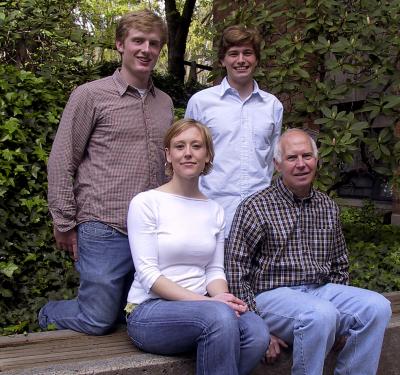
If you ask about Professor Jim Morrow at the 91±¬ĮĻ math department, people tend to use words like ā€œamazing,ā€ ā€œastoundingā€ and ā€œwizard.ā€
Itā€™s no wonder. A student trio he coached has taken top honors in a highly competitive global math competition, keeping pace with such math powerhouses as MIT, Harvard and the University of California at Berkeley.
Yet again.
This is the fifth such win for Morrowā€™s teams in four years in the annual Mathematical Contest in Modeling, sponsored by the Consortium for Mathematics and Its Applications. Of 828 teams competing, the 91±¬ĮĻ team was one of just 13 judged as ā€œOutstanding Winners.ā€ The 91±¬ĮĻ students also received an award from the Institute for Operations Research and Industrial and Applied Mathematics, given to the best of the winning groups, setting them on an even higher tier. Another 91±¬ĮĻ team achieved a ranking of ā€œMeritorious.ā€
ā€œHe is a magician,ā€ says Selim Tuncel, department chairman. ā€œHe constantly gets comments from around the world. People ask him what his secret is.ā€
According to this yearā€™s winning group, much of that secret lies in simply being engaged and involved with the students.
ā€œHeā€™s been great,ā€ said Braxton Osting. ā€œHe really helped guide us.ā€
ā€œAnd heā€™s very approachable,ā€ added Christina Polwarth. ā€œHeā€™s always willing to help with whatever we need.ā€
Morrow gives the bulk of the credit back to the students.
ā€œThese kids just come with a good attitude,ā€ he said. ā€œI really like working with these students, who love mathematics and want to do mathematics. Not just passively, but actively. I enjoy watching them develop, and perhaps having some effect on them. I know they are going to develop and improve ā€” I donā€™t have to make them improve.ā€
Osting, Polwarth and Ryan Bressler, the third member of the winning team, all seniors, are from the Puget Sound area. Two members, Osting and Bressler, are products of the stateā€™s public education system. They got to know each other about three years ago in an accelerated advanced calculus class taught by Morrow.
That class, according to Bressler, prepared the group for the contest in more ways than one.
ā€œFrom an endurance perspective, it probably got us ready,ā€ Ryan said. ā€œThe class kept us up working late a lot. I remember one week we had two assignments and a midterm.ā€
Polwarth smiled at the recollection and shook her head. ā€œI could have killed him.ā€
But all agreed that the class, and others they subsequently took from Morrow, helped while in the midst of the grueling four-day competition.
The contest began at 5 p.m. on Feb. 3, when officials posted two problems on the Web. The teams had until 5 p.m. Feb. 7 to select one of the two, devise a solution, write it up and submit it. Morrow arranged for the teams to have 24-hour computer access and a comfortable place to work, but couldnā€™t otherwise help beyond rallying the studentsā€™ spirits as the sustained effort took its toll.
Participants say the experience involved little sleep and a lot of caffeine.
ā€œCoffee was our friend,ā€ Polwarth said. Her teammates laughed.
ā€œOn the second night, we took a break and went to Starbucks right as it was closing,ā€ Bressler said. ā€œChristina got five shots of espresso.ā€
ā€œFour,ā€ Polwarth interjected. ā€œI think it was just four.ā€
The three said it didnā€™t take long to select which problem to do. The first choice involved modeling flooding downstream if the earthen dam that forms Lake Murray in central South Carolina fails during a catastrophic earthquake. The second asked teams to model traffic flow for a tollbooth plaza on a multi-lane highway and determine the optimal number of tollbooths to deploy to keep traffic flowing. The 91±¬ĮĻ team selected the dam scenario.
ā€œPart of it, I think, was so we could refer to it as ā€˜the damn problem,ā€™ā€ quipped Bressler. ā€œBut I think we also decided we wanted to challenge ourselves more.ā€
ā€œIt did sound more interesting,ā€ Osting agreed.
One of the strengths of the team was the varied talents of its members, Polwarth said. Her teammates are good at grasping the overall scenario and deciding what direction to take.
And Polwarth is a good hands-on equation solver, Bressler said. ā€œSheā€™s really good at busting through the algebra.ā€
Polwarth countered, ā€œIā€™m the only one in the group with the patience to do it.ā€ She added that Osting and Bresslerā€™s outdoorsman tendencies helped as well. The pair rock climb together, and also enjoy kayaking.
ā€œWe went to our kayaking data to calculate the river flow,ā€ Osting said.
ā€œWe know all the Web sites to go to for that,ā€ Bressler added.
ā€œI was in awe of their knowledge,ā€ Polwarth said. ā€œI donā€™t go outdoors that much. Iā€™m more of a coffee shop person.ā€
In the end, they finished the mathematical portion of the task with five hours to spare, then had to push hard to write it up. Again, Morrowā€™s guidance came into play.
ā€œThey are all also very good writers,ā€ Morrow said, adding that itā€™s a skill he tries to stress as necessary to his students. ā€œYou can be a very good mathematician, but if you canā€™t explain what you did thatā€™s a big handicap.ā€
The winning streak is helping to boost the departmentā€™s prestige, Tuncel said ā€” mostly in that it highlights the outreach efforts that Morrow makes in terms of the multiple programs he conducts to engage and involve students.
ā€œWe had our 10-year review this year, and the group that made the site visit stressed how unusual it is for a large university to have the level of closeness and involvement that we have here,ā€ he said. ā€œThey made it clear that there is nothing like it anywhere else in the country.ā€
At the end of the exit interview, he added, one of the visitors suggested cloning Morrow. Tuncel pondered the sentiment, but decided that wouldnā€™t be enough, at least not right away.
ā€œJim has been doing this for 20 years, going over and above the kind of involvement that comes with just teaching,ā€ he said. ā€œIt has taken time to build this level of rapport and involvement. I think it has been a lot of hard work, and weā€™re just seeing the results now.ā€
More information about the contest and copies of papers submitted by the student teams are available on Morrowā€™s Web site at:
Overall contest results are available at: