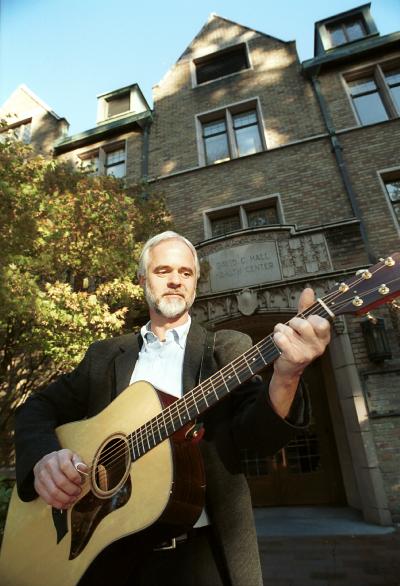
Itā€™s as if Michael Stern listened to some of his own advice.
The singer-songwriter, who also works as a family nurse practitioner and research clinician at Hall Health, included five songs written by other artists on his latest release, Dance. Thatā€™s a new approach for the veteran folk singer whose five previous compact discs included almost exclusively his own original songs. Stern and his fans will celebrate the release of the CD during a 12:30 p.m. performance on Sunday, Nov. 16 at University Baptist Church, 4554 12th Ave. N.E.
ā€œMaybe I was trying to prove something,ā€ Stern said about his prior inclination to record only his own material.
ā€œIn some ways the title track, Dance, talks about that. Just be yourself. Who cares? ā€˜Dance as if no one was watching and sing as if no one could hear.ā€™ So maybe thatā€™s why Iā€™m just wanting to record what feels right and sounds good. Itā€™s about letting go.ā€
And it continues to be about a range of social issues too. Stern is known for having an activist, peace-loving bent to his music. But heā€™s beginning to think it might be more accurate to describe his music as an extension of his work at Hall Health. In both cases heā€™s simply trying to heal people.
Thatā€™s a theme Stern has been considering ever since a trip he took several years ago to Africa where he did some volunteer work for Habitat for Humanity. During that trip, he met with an African storyteller/healer who said he and others like him had been using music to help heal their patients for generations.
ā€œThey had clients come into their home who might have health problems or emotional or relational problems,ā€ he said. ā€œThe storyteller/healer would play the mbira until they all went into a trance. That was their therapy. Then, at the end of the session, they felt improved or healed or that their issues had been addressed. I found that a kind of intriguing parallel to what I was thinking about with my music.ā€
Stern wonā€™t be bringing African musical instruments to his office anytime soon. But fans of his music know that themes of healing have always been a part of Sternā€™s work. Sometimes the message is directed at individuals, sometimes at government leaders and sometimes at society at large. In addition to Dance, each of these songs from the new CD has a little something to do with healing:
- Take Only What You Can Carry is a haunting and timely look back at the internment of Japanese Americans during World War II. The songā€™s relevance today is clear as the debate between civil liberties and a nationā€™s safety and security rages on with unmistakable racial, or racist, undertones.
- Any Fool is a reference to a famous quote by John Muir, the father of our national parks system. But instead of only making an environmental statement, Stern added to the message to deliver a powerful critique of war and retaliation.
ā€œAny fool can declare war before he knows what weā€™re fighting for. Any fool can retaliate without knowing who it is that they hate. These are the fools who often say what a shame that the innocent got in the way. The same ones who claim to have seen the light and are sure what theyā€™re doing is right.ā€
- Providence is a song that Stern says heā€™s particularly proud of. It embraces individual differences, sexual orientation specifically.
The thoughtful, left-leaning themes are nothing new for Stern. His signature songs are straight out of the tradition that shaped him in his youth. He was a fan of Bob Dylan and Joan Baez when he first started writing music in the late 1960s and 70s.
Heā€™s perhaps best known for the songs Stand Up, inspired by the famous quote by Nazi concentration camp survivor Martin Niemoller, and Fight No More Forever, inspired by the concessionary speech of Nez Pearce leader Chief Joseph.
But Stern insists thereā€™s more than weighty issues involved in his music. In fact, the tune Waltzing Around in the Nude, one of the cover songs on the new release, is quickly becoming a favorite at live performances.
ā€œLaughter at my concerts is definitely allowed and perfectly legal,ā€ Stern said.
That, like the cover songs, is a relatively new twist. Stern says he realized somewhere along the line that you canā€™t drop too many heavy messages on an audience without also providing some comic relief. Perhaps thatā€™s just another sign of his letting go, his evolution as an artist. If so, it could be a sign that Sternā€™s music career ā€” a career that he says will continue until the day he dies ā€” is just getting ready to take off.
ā€œI think among great artists, painters, musicians, composers, speech writers, even athletes, the greatest ones talk about the letting go being the point at which their greatest work occurs. In other words, thereā€™s no substitute for discipline and practice and all the stuff that makes someone technically great. But itā€™s those who manage at the peak of their preparation to release themselves to just fly.
ā€œFrom a creative point of view thatā€™s more what Iā€™ve been experiencing as I write songs. Practice, yes. Discipline, yes. But then at the point of a performance or the point of creative experience, you have to let go. Thereā€™s no technical skill that can match creative release.ā€